
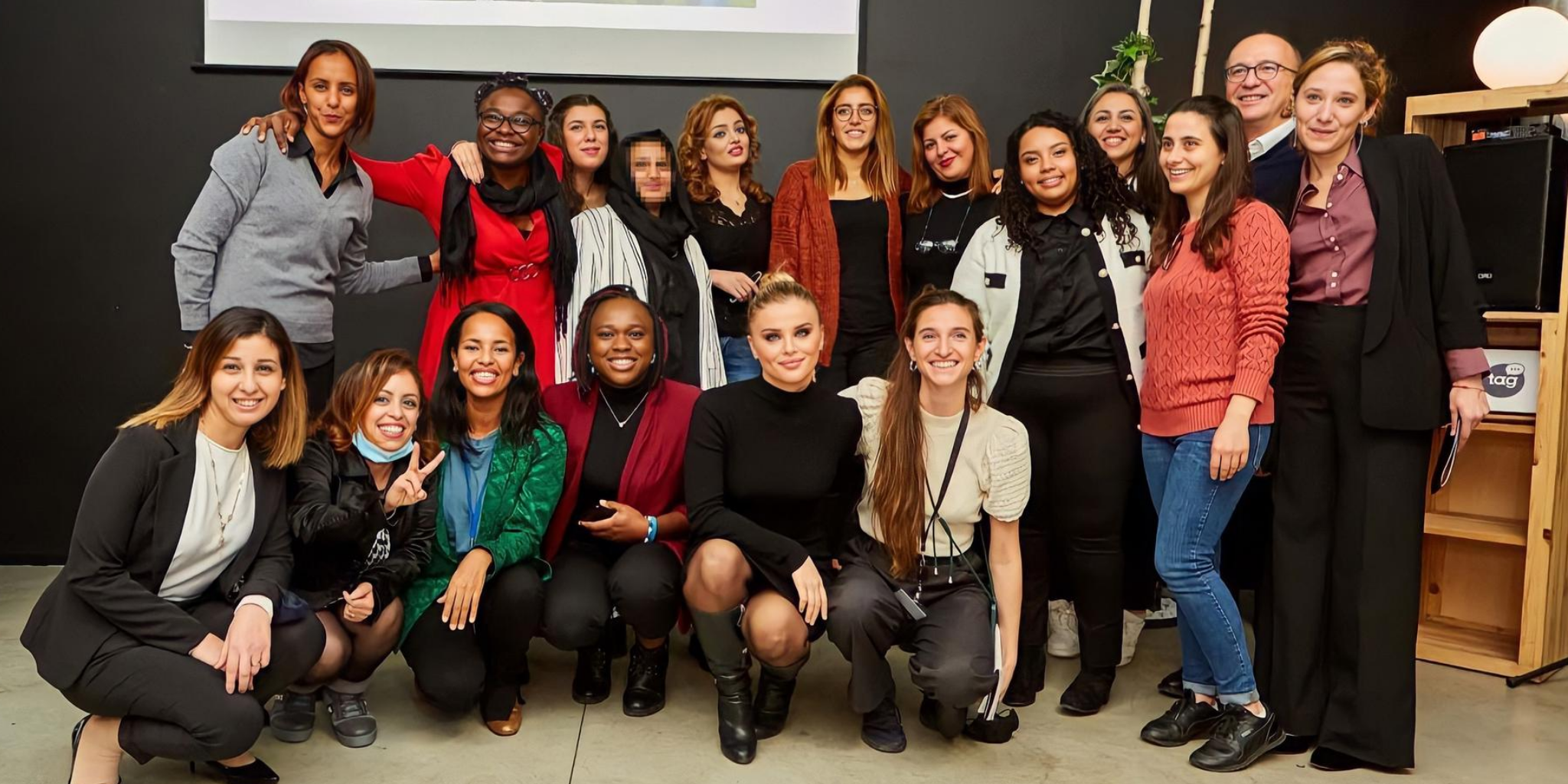
Yo soy Anita, yo soy una mujer, yo soy ebrea, yo soy Albanian by birth and Italian by adoption and training, because I was a migrant.
I, above all, am a child of my history: the child of two diasporas, my great-grandmother's Jewish diaspora first and my Albanian people's diaspora later.
I am very honored to have been the godmother of #TECH4WOMEN, an event organized by Techfugees that stands out for its righteous commitment to recognizing diversity as a common good and common sense as the only way forward so that new trajectories capable of including and growing a sustainable, female-driven economy can emerge.
Female, yes. Because you see every day the migrants, these human beings that the world of inequality and inequity is pushing north. You see every day how this issue is generating a structural problem in relations between Italy and France, between Italy and Germany, between Italy and the European Union. Most of them are male. From the places of revolts, civil war and dictatorships mostly the male gender flees. The percentage of females is really very low. Because women remain at home, in war zones, they remain to face alone what remains of revolutions, uprisings, persecutions, to rebuild after death, to be reborn, waiting perhaps one day for their men to return.
Women who have been left behind are single-handedly fulfilling the task of refounding society, of bringing it out of its semi-tribal or dictatorial state. But from them, the most, who stayed behind, as from those who dared to cross the Mediterranean comes a new challenge: to come to terms with clichés, with the idea that because things have always been this way, then nothing can ever change. Because once even they take the sea route, there is reckoning to be done with the crossing and what awaits you on the other side.
I think of me, for example. With a degree in Philosophy taken in Italy as an immigrant, my prospects as a worker were really limited. Like so many young people, having completed my studies, my job, in the months following graduation, was to look for one. I remember hundreds of resumes sent out, an infinitesimal portion of which, led me to job interviews that somehow all ended the same way: "you're too prepared," or "but what's a girl like you doing here," or finally, ça va sans dire, "Why don't we talk about it over dinner?"
And so it was that I was faced with the urgency of a decision: if no one would choose me, I had to choose myself. And while I was trying to learn more about everything, meanwhile, I was working every job I could: babysitter, caregiver, model, waitress, Latin and Greek tutoring, interpreter at fairs, translator of texts (of course, also having to fight to get paid). It touched me to realize that the mechanism that kept Italy on its feet had jammed. There were no policies for young people and, more specifically, for women. In short, it seemed that girls, in order to secure a job, had to sell out to the lowest bidder every time. I really had the physical feeling that I was still on the high seas and had not touched land. So if I am an entrepreneur today, it is not just because I had more courage than my Italian peers, but simply because I have known the open sea. And, in the middle of the sea, like it or not, you have to learn to swim.
Lascia un commento