
The knowledge economy is redefining the way businesses and academic institutions interact, accelerating a transformation that sees education and research as the pillars on which the future is built.
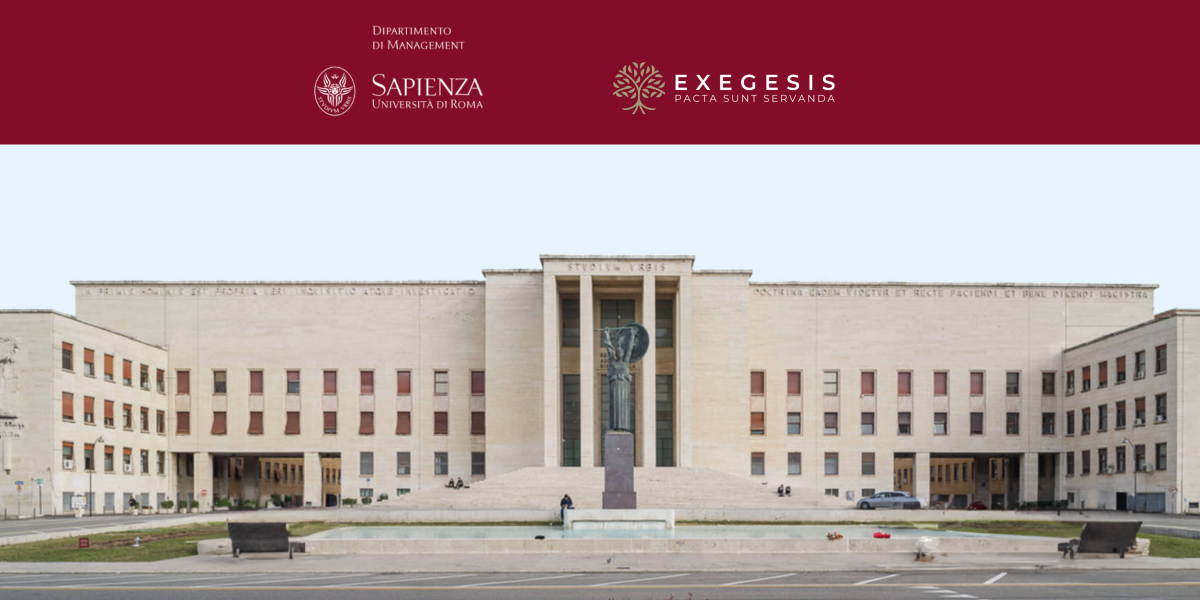
It is in this scenario that the agreement between Exegesis and the Department of Management of Sapienza University of Rome, a collaboration that aims to integrate academic knowledge with the dynamics of innovation specific to the corporate world.
This synergy is not limited to a simple interaction between university and business, but takes the form of a true laboratory of experimentation, where critical thinking and operational practice come together to generate useful and applicable knowledge.
Education and research: the strategic node of the future
If the past was marked by the centrality of physical and financial capital, the 21st century has brought to the fore a new strategic asset: knowledge. It is no coincidence that, in a context of increasing technological and social complexity, the issue of training is now more crucial than ever for the competitiveness of companies and institutions.
Training is no longer a linear process, limited to the university course or professional development, but a continuous cycle, an ecosystem in which learning, experimentation and innovation feed off each other.
The agreement between Exegesis and Wisdom is situated within this transformation, offering itself as a model of collaboration capable of responding to three major challenges:
- Technological acceleration: artificial intelligence, automation and digitization are redefining the very concept of expertise. Training new professionals means not only teaching tools, but educating in the ability to adapt to and interpret change.
- The interdisciplinarity of knowledge: the challenges of the future require overcoming rigid separations between disciplines. Research and education must evolve toward a hybrid model in which economics, technology, philosophy and social sciences dialogue to generate innovative solutions.
- The integration of theory and practice: academic knowledge and business experience must converge in an experiential training model, in which the student becomes an active player in his or her own journey. A new paradigm for innovation.
The agreement between Exegesis and the Department of Management at Sapienza University represents a piece of this evolution, with a specific focus on the Excellence Pathway of the Bachelor of Business Management degree program., the most chosen in the Faculty of Economics. The goal is to create an advanced learning environment in which academic research and business challenges are intertwined in a logic of reciprocity and shared growth.
Planned activities include:
- Joint research projects to develop new theoretical and application perspectives;
- Mentorship and support for students to guide them in acquiring strategic skills;
- Outreach initiatives and conferencesto disseminate and share knowledge;
- Educational and vocational internships, to create direct connections between universities and the labor market.
Beyond education: a new ethics of knowledge
This collaboration is not limited to providing technical tools or career opportunities. It is part of a broader reflection on what it means to educate in an era of radical transformation. Education can no longer be conceived as a unidirectional transmission of information, but as a process of building critical thinking.
In the world of fluid knowledge, where skills quickly become obsolete and the ability to learn is the true competitive value, the goal must be to train individuals capable of navigating complexity, interrogating the present and building the future.
In fact, innovation is not only a technological issue, but above all a cultural issue. It is the result of a vision capable of connecting past and future, theory and practice, specialization and multidisciplinarity. The agreement between Exegesis and Sapienza moves precisely in this direction: to build a model of research and education that does not just respond to the needs of the present, but knows how to anticipate and guide change.
Lascia un commento